Say what must be true
A short spec: the entities, what happens to them, and requirements such as durable, shared by several instances, never lost, in order.
tilegen is a compiler from architectural requirements to a Go project. You say the data must survive a restart and no event may be lost. It picks the database, the broker, the transport, the sign-in and the secrets at the lowest cost, writes the code, and shows why.
01 / The tour
Recorded against tilegen v0.3.5 itself: the studio is the real compiler, and the terminal chapter is real output. Captions are on screen; there is no sound. Pick a chapter or let it play through.
02 / How it works
Most scaffolding starts by asking which database you want. tilegen starts one step earlier, with what the system has to do, and treats the choice of tools as something to compute.
A short spec: the entities, what happens to them, and requirements such as durable, shared by several instances, never lost, in order.
A tile is one concrete way to meet a need. Each declares what it guarantees, what rules it out, and six costs, from work left for an LLM to what it takes to operate.
tilegen finds the lowest-cost set of tiles that can do everything asked, using the tree tiling that compilers use to select instructions. Your team's weights set the prices.
Types, interfaces, SQL, protobuf, wiring and a lock file are generated. What needs judgment is left as a typed method with its intent written down.
(project orders
  (module github.com/acme/orders)
  (go 1.22)
  (require (uuid github.com/google/uuid v1.6.0))
  (app)

  (package orders
    (entity Order
      (field ID uuid.UUID)
      (field CustomerEmail string)
      (field TotalCents int64)
      (store get list save (durable) (cross-process)))

    (events
      (durable) (at-least-once) (cross-process)
      (event OrderPlaced (field OrderID uuid.UUID))
      (outbox Order))

(api (get Order) (list Order) (save Order) (typed-clients))))$ tilegen explain spec.sexp orders.API (api) needs: typed-clients chosen by: auto chosen connect score 16 llm 2·4 + maint 2·3 + dep 2·1 grpc score 17 llm 2·4 + maint 2·3 + dep 3·1 illegal http-json there is no schema: every client writes its own requests and types ... orders.Bus (event-bus) needs: durable, at-least-once, cross-process chosen by: auto chosen nats-jetstream score 47 llm 5·4 + maint 3·3 + dep 4·1 + run 2·1 + ops 4·3 kafka score 70 llm 5·4 + maint 5·3 + dep 4·1 + run 4·1 + ops 9·3 illegal local-bus an in-process bus loses undelivered events on restart illegal nats-core core NATS is fire-and-forget: a message with no connected subscribe... illegal rabbitmq unverified: a durable exchange, a durable queue and persistent mess... illegal redis-streams durability is an operator setting: under the default append-only po... orders.OrderStore (store) needs: durable, cross-process, outbox chosen by: auto $ tilegen -out orders spec.sexp ... 7 open LLM task(s), 0 hole(s) already filled -> orders/tilegen.tasks.json next: cd orders && buf generate && sqlc generate && go mod tidy && go build ./...
What it does not do. tilegen writes everything that follows from the spec, and the
project builds. It does not write your business logic: store and bus method bodies are left as holes,
each a typed method with its intent, for you or an LLM to fill. tilegen prompt prints a
self-contained prompt for each one.
03 / The catalogue
Ask for something a tile cannot do and it is ruled out, with the reason in its own words. Ask for things no tile can do together and tilegen refuses, and says why each one is out.
04 / The studio
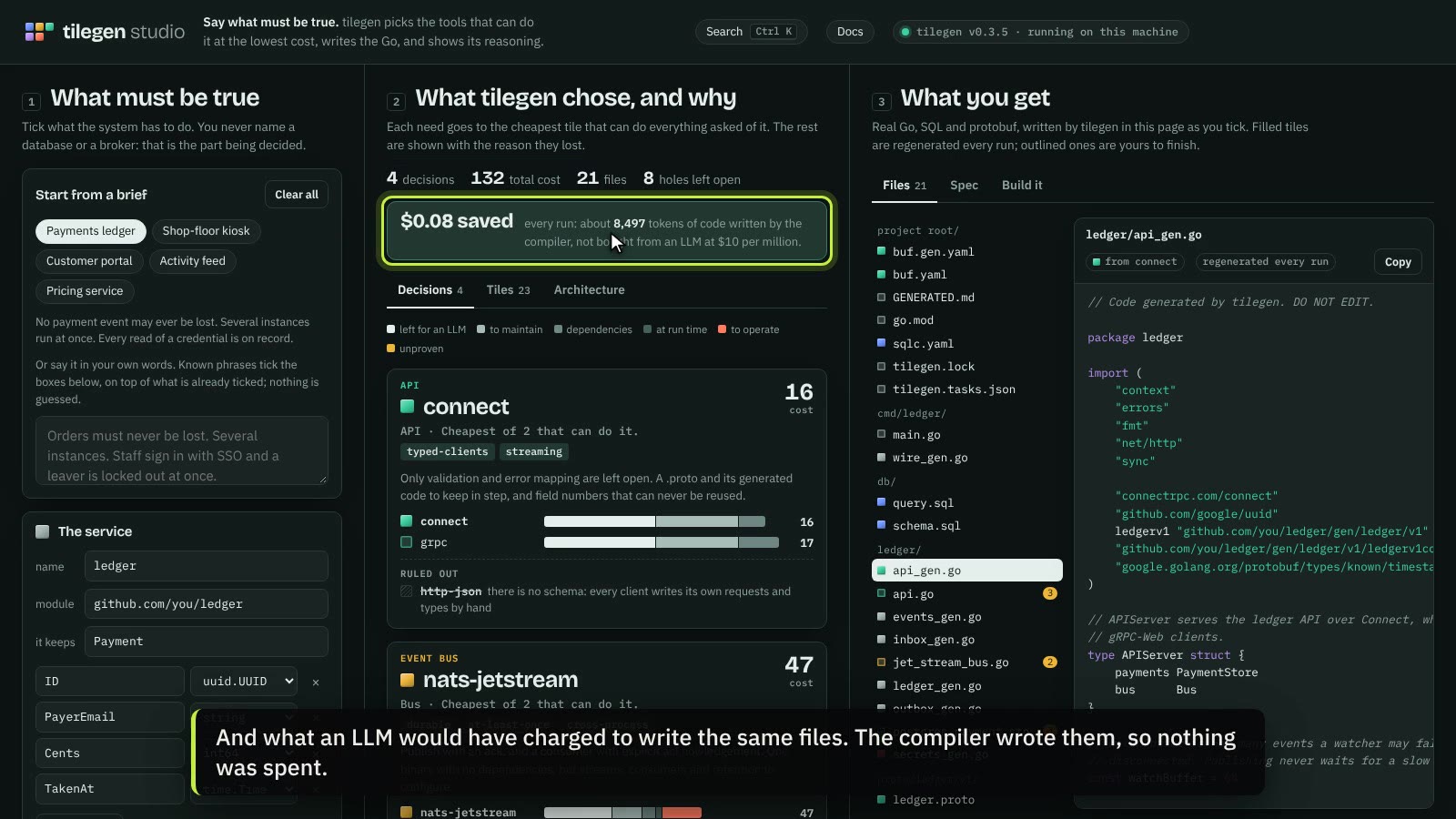
The studio is tilegen compiled to WebAssembly, running in your browser. Nothing you type leaves the page. Tick requirements, read why each tile won, open the architecture diagram, and download the project as a zip.
05 / Install
Go is the only thing tilegen itself needs. Some tiles need a build tool, such as sqlc or buf; tilegen says which, and prints the command to run.
$ brew install vinodhalaharvi/tap/tilegen
# or: go install github.com/vinodhalaharvi/tilegen@latest

$ tilegen explain spec.sexp      # why each need got its tile
$ tilegen -out orders spec.sexp   # write the project
$ tilegen check spec.sexp        # for CI: stale code or open holes fail
$ tilegen serve                  # the studio, from the same binary
$ tilegen -out orders spec.sexp
  ...
7 open LLM task(s), 0 hole(s) already filled -> orders/tilegen.tasks.json
next: cd orders && buf generate && sqlc generate && go mod tidy && go build ./...

$ cd orders && buf generate && sqlc generate && go mod tidy && go build ./...
06 / Documentation
The documentation here is the repository's own, so it cannot drift from the code it describes.
Open source
Every cost, every guarantee and every rule that rules a tile out is a line in the repository. If you disagree with one, change the weight, switch the tile off, or send a pull request.